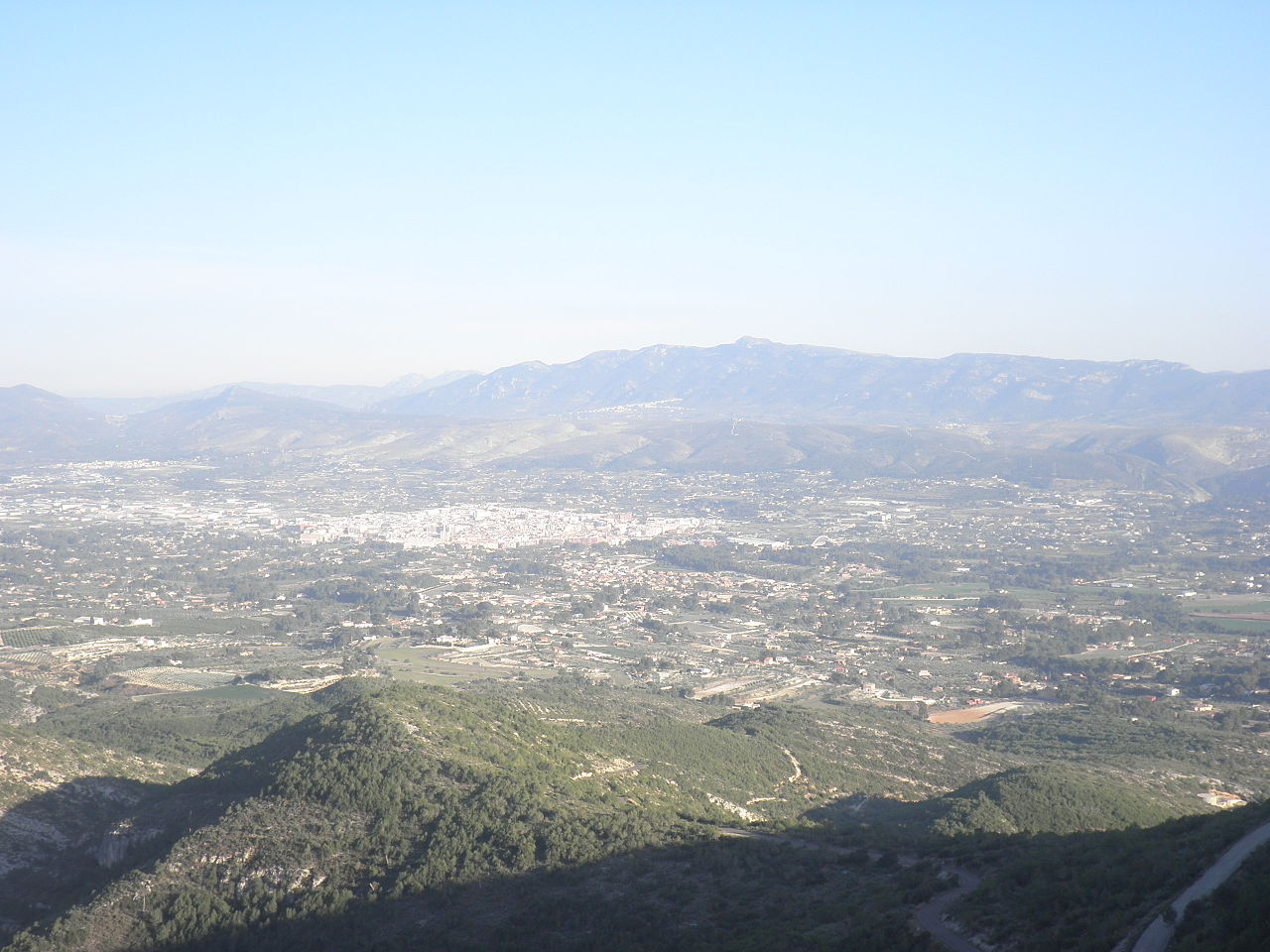
Valencia · Comunidad Valenciana
Ontinyent
- Province
- Valencia
- Status
- Conjunto Histórico
- Population
- 37,012
- Elevation
- 382 m
Ontinyent is a heritage town in the province of Valencia, Comunidad Valenciana, Spain. It is designated a Conjunto Histórico (Spain's national heritage designation for historic ensembles). Population 37,012 (2025), elevation 382m.
A Valencia province town where a bell tower, the tallest in the Comunidad Valenciana, rises above a river, a medieval bridge, and streets that have been continuously settled since the Bronze Age.
Key facts
- Province
- Valencia
- Heritage status
- Conjunto Histórico
- Population
- 37,012 (2025)
- Elevation
- 382 m
History of Ontinyent
The land around Ontinyent has been occupied for a very long time. The earliest traces go back to the final stages of the Neolithic period, visible at sites like El Castellar and the Arenal de la Costa, the latter also showing Chalcolithic characteristics. The Bronze Age left the richest prehistoric record: during what archaeologists call the Valencian Bronze period, from around 1900 BC, the area supported a network of hilltop settlements focused on farming and herding.
The most significant site is the Cabezo de Navarro, where finds include polished stone tools, plain pottery, and copper and arsenical bronze awls. Schematic rock art survives at the Abrigo del Gigante. There is no evidence that Phoenician or Greek colonisers reached this territory directly, though Iberian peoples were present from at least the 2nd century BC, and several Iberian sites were later shared with Roman settlers.
The Iberian population here used wheel-thrown pottery, iron tools, and coinage, likely connected to the nearby mint at Saitabi, along with their own writing system. The most significant Ibero-Roman sites include La Casa Calvo and El Pontó.
Heritage & Monuments
The church of Santa María is the most prominent building in town. Its bell tower stands 72 metres tall, making it the highest in the Comunidad Valenciana and the second highest in Spain. The church blends Romanesque, Gothic, and Renaissance elements.
Inside, the high altar features nineteen paintings by the artist José Segrelles, installed in 1945, and two works by sculptor Mariano Benlliure: a figure of La Soledad and a recumbent Christ. At the entrance sits a stone tomb that once held the remains of Lope Vaillo de Calderón, a captain involved in the conquest of the town. The Old Bridge, El Puente Viejo, crosses the river Clariano and dates to around the 16th century.
A 2018 renovation revealed a previously unknown arch buried under sediment. The Carmelite convent has been a closed papal community since 1575, and the convent structure itself was built in 1500–1501. The Teatro Echegaray on Plaza de Santo Domingo opened in 1918, built by a group of local industrialists; it was named after the playwright José de Echegaray and fully modernised in 2010.
Just outside town, Pou Clar is a natural site where the river has carved stone pools deep enough for swimming, widely used by locals in summer.
Museums in Ontinyent
Museum data and ratings from Google. Check opening hours before you go.
Where to stay in Ontinyent
Hotels, guesthouses and holiday rentals in and around Ontinyent, with live prices.
Search all places to stay in Ontinyent on Booking.com →Affiliate links: if you book, Castizo Spain may earn a commission at no extra cost to you. More
Where to eat in Ontinyent
Ratings & restaurant data from Google.
Regional food & drink
Comunidad Valenciana is known for Paella valenciana, Fideuà and Horchata, among 5 regional specialities.
Watch: Turrón
Gallery
Location
Quick answers
Is Ontinyent worth visiting?▾
A Valencia province town where a bell tower, the tallest in the Comunidad Valenciana, rises above a river, a medieval bridge, and streets that have been continuously settled since the Bronze Age.
Why is Ontinyent a heritage town?▾
Ontinyent is officially designated a Conjunto Histórico, Spain's national heritage designation for historic ensembles.
What is the traditional food in Comunidad Valenciana?▾
Comunidad Valenciana is known for Paella valenciana, Fideuà, Horchata and All i pebre. You'll find these regional specialities in and around Ontinyent.
What is there to see in Ontinyent?▾
The church of Santa María is the most prominent building in town. Its bell tower stands 72 metres tall, making it the highest in the Comunidad Valenciana and the second highest in Spain.
What is the history of Ontinyent?▾
The land around Ontinyent has been occupied for a very long time. The earliest traces go back to the final stages of the Neolithic period, visible at sites like El Castellar and the Arenal de la Costa, the latter also showing Chalcolithic characteristics.
Which heritage towns are near Ontinyent?▾
Nearby heritage towns include Bocairent, Montesa, Cocentaina and Alcoy.
Nearby heritage towns
A hilltop town in Valencia province where a medieval quarter of steep, winding lanes rises above prehistoric cave sites, a Moorish castle site, and Spain's oldest bullring cut entirely from rock.
Above the Valencia plain, Montesa's ruined castle-monastery, birthplace of a medieval military order and twice shaken by earthquake, stands as one of the region's most dramatic pieces of standing history.
A town in Alicante province where a Gothic-military castle crowns the hill above a medieval Arab quarter whose streets have barely changed in eight centuries.
An industrial-revolution city in Alicante province, built across deep river gorges, with a Gothic tower, a medieval castle, a Santiago Calatrava underground hall, and a local coffee liqueur dating back eight centuries.
A hilltop city in Valencia province whose castle and old town walls have watched over the plain since the Middle Ages, and whose streets connect to both the Camino del Cid and one of the longest histories of human settlement on Spain's Mediterranean coast.
A fortified frontier town in Alicante province, its hilltop castle bearing the Latin motto "I close and open the kingdom", and a Gothic aqueduct, medieval gateway, and ancient castle vault to prove the claim.
A castle town in Alicante province whose Bronze Age treasure, medieval fortress, and Gothic-Renaissance church mark it as one of the most historically layered stops on the Valencian stretch of Spain's inland roads.
A small hamlet in Alicante province that grew up entirely around a Renaissance sanctuary, whose patron virgin draws crowds of 25,000 for one of the region's most-attended summer pilgrimages.
An island town on the Júcar river in Valencia whose medieval walls, Gothic-Renaissance town hall, and deep ties to the conquering king Jaume I once made it the gateway that opened and closed an entire kingdom.
Visiting from a nearby city?
Ontinyent makes a great day trip from:
Last updated 18 July 2026.