Navarra · Navarra
Sangüesa
- Province
- Navarra
- Declared
- 2000
- Status
- Conjunto Histórico
- Population
- 4,883
- Elevation
- 404 m
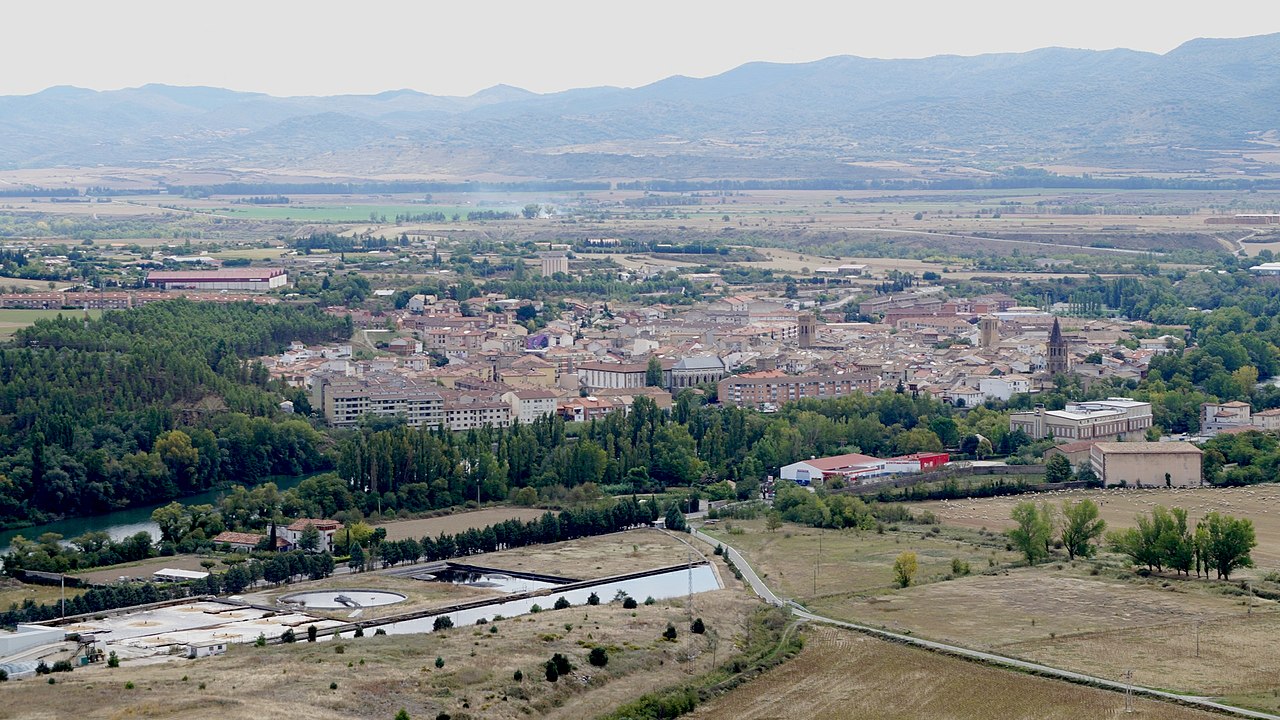
Sangüesa is a heritage town in the province of Navarra, Navarra, Spain. It was designated a Conjunto Histórico (Spain's national heritage designation for historic ensembles) in 2000. Population 4,883 (2025), elevation 404m.
A royal frontier town on the Camino de Santiago in Navarra, where medieval palaces line every street and one of the most complex Romanesque church facades in Spain stops travellers in their tracks.
Key facts
- Province
- Navarra
- Heritage status
- Conjunto Histórico (declared 2000)
- Population
- 4,883 (2025)
- Elevation
- 404 m
History of Sangüesa
The land around Sangüesa has been occupied since the Bronze Age, when polished axes and flint tools were left behind at open-air sites. Later, the area is associated with the Suessetani, a Celtic people of Gaulish origin whose capital, Corbio, some scholars have placed near the present town. In 184 BC the Roman praetor Aulus Terentius Varro defeated them, sold the population into slavery, and the city vanishes from the record, though the reasons the Suessetani shifted from Roman allies to enemies remain unclear.
Roman settlement across the area was extensive, and the finds were notable: an Etruscan-style bronze horse bridle, now in the National Archaeological Museum since 1913, a marble bust of Artemis, and a Roman inscription still visible on a bridge pier over the Aragón river. The town as it stands grew from two nuclei. The original settlement, Sangüesa la Vieja, is identified with nearby Rocaforte.
Around 1090, King Sancho Ramírez granted the first urban core the Fuero of Jaca, and in 1122 Alfonso I the Battler extended that charter to the Burgo Nuevo on the current site. In 1312, at the Battle of Valdoluengo, the people of Sangüesa captured the Aragonese royal standard. King Louis X rewarded them by adding the Aragonese bars to the town's coat of arms and the title "La que nunca faltó", the one that never failed.
Heritage & Monuments
Sangüesa's entire monumental ensemble is listed as a protected cultural asset and the town sits on the Camino de Santiago. The saying goes that there is a monument on every street, and walking around bears that out. The most celebrated building is the Church of Santa María la Real, a three-nave Romanesque structure donated in 1131 by Alfonso I the Battler to the Order of St John.
Its octagonal tower is Gothic, but its great Romanesque portal is the real draw, one of the most intricate works of medieval art in Navarra, packed with religious imagery including a figure of Our Lady of Rocamador, and signed by the sculptor Leodegarius. The Palace of the Kings of Navarra, also known as the Palace of the Prince of Viana, is a fortified medieval palace that still retains its defensive wing and crenellated towers. The town hall alongside it is a Renaissance building from 1570, one of the oldest in Navarra.
The Palace of the Marquesses of Valle-Santoro, built by a viceroy of New Spain, has a striking colonial-influenced wooden eave, among the most spectacular in the region, and now serves as the Casa de Cultura. The old bridge over the Aragón river dates to an original commission by Sancho Ramírez. Four of its seven Romanesque arches survive, and a Roman inscription is embedded in one of its piers.
The hilltop castle, the Castellón, is largely ruined but the remains of its keep are still visible above the town.
Museums in Sangüesa
Museum data and ratings from Google. Check opening hours before you go.
Where to stay in Sangüesa
Hotels, guesthouses and holiday rentals in and around Sangüesa, with live prices.
Search all places to stay in Sangüesa on Booking.com →Affiliate links: if you book, Castizo Spain may earn a commission at no extra cost to you. More
Where to eat in Sangüesa
Ratings & restaurant data from Google.
Regional food & drink
Navarra is known for Espárragos de Navarra, Pimiento del Piquillo de Lodosa and Chistorra, among 6 regional specialities.
Traditional food & drink in Navarra →Fiestas in Sangüesa
Dates recur annually but can shift by a few days. Confirm with the ayuntamiento before planning a trip around one.
- San Sebastián20 January
Gallery
Location
Quick answers
Is Sangüesa worth visiting?▾
A royal frontier town on the Camino de Santiago in Navarra, where medieval palaces line every street and one of the most complex Romanesque church facades in Spain stops travellers in their tracks.
Why is Sangüesa a heritage town?▾
Sangüesa is officially designated a Conjunto Histórico, declared in 2000, Spain's national heritage designation for historic ensembles.
What is the traditional food in Navarra?▾
Navarra is known for Espárragos de Navarra, Pimiento del Piquillo de Lodosa, Chistorra and Queso Roncal. You'll find these regional specialities in and around Sangüesa.
What is there to see in Sangüesa?▾
Sangüesa's entire monumental ensemble is listed as a protected cultural asset and the town sits on the Camino de Santiago. The saying goes that there is a monument on every street, and walking around bears that out.
What is the history of Sangüesa?▾
The land around Sangüesa has been occupied since the Bronze Age, when polished axes and flint tools were left behind at open-air sites. Later, the area is associated with the Suessetani, a Celtic people of Gaulish origin whose capital, Corbio, some scholars have placed near the present town.
When are the fiestas in Sangüesa?▾
Sangüesa celebrates San Sebastián (20 January). Dates recur annually but can shift by a few days.
Nearby heritage towns
An abandoned medieval village in Navarra, its castle ruins and fragmentary walls standing silent inside a private estate since the last residents left in the 1950s.
Birthplace of Ferdinand II of Aragon, this hilltop fortress town in Zaragoza province still wears its medieval skin, castle, walls, Romanesque crypt and Renaissance palaces stacked up the same rocky outcrop they have occupied for a thousand years.
A fortified Romanesque church crowns this hilltop village in Navarra, its battlemented towers and three ancient apses watching over the plains of the Ribera below.
A fortified Aragonese town set on a rocky outcrop above two rivers, its six Romanesque churches, castle, and medieval street plan standing largely unchanged since the twelfth century.
The royal palace of the Kings of Navarre rises above Olite's walled medieval streets, its towers and gardens once counted among the finest in Europe.
Artajona rises above the Navarrese plain behind medieval walls that enclose a Gothic church, a stone-arched fountain, and dolmens that predate any city in Spain.
Capital of Navarra and one of the great cities on the Camino de Santiago, Pamplona carries 75,000 years of human settlement within its medieval walls, Roman foundations, and Gothic cathedral.
A Pyrenean stone village in Huesca, Aragón, where narrow medieval passageways thread between ancient houses and bears still roam the surrounding mountains.
A mountain valley town in Huesca where the Crown of Aragon was born, the river Aragón Subordán runs past megalithic monuments and a surviving Romanesque monastery church that once housed 150 monks.
Visiting from a nearby city?
Sangüesa makes a great day trip from:
Last updated 9 July 2026.