Valladolid · Castilla y León
Tordesillas
- Province
- Valladolid
- Status
- Conjunto Histórico
- Population
- 8,773
- Elevation
- 704 m
Tordesillas is a heritage town in the province of Valladolid, Castilla y León, Spain. It is designated a Conjunto Histórico (Spain's national heritage designation for historic ensembles). Population 8,773 (2025), elevation 704m.
Sitting above the Duero on the old road between northwest Spain and the Castilian heartland, Tordesillas is where a treaty once divided the New World and where a queen spent forty-six years confined in a royal monastery.
Key facts
- Province
- Valladolid
- Heritage status
- Conjunto Histórico
- Population
- 8,773 (2025)
- Elevation
- 704 m
History of Tordesillas
The site began as a fortified high ground used to watch over the empty plains of early Castile, alongside similar lookout points at Zamora, Toro and Simancas. In the tenth century, García, eldest son of Alfonso III, used this prominence as a base for repopulating the region with Mozarabs and settlers from Asturias and León, giving the town its essentially Asturian-Leonese origins. After a period of collapse and depopulation following the raids of Almanzor, recovery came slowly under the Castilian count Sancho García.
Early documents call the place Oterdesillas. Through the Middle Ages it belonged to the bishopric of Palencia and formed part of the Merindad del Infantazgo de Valladolid under the Crown of Castile. The town passed through the hands of several queens and royal favourites, among them Leonor de Guzmán, María de Portugal, María de Padilla, Juana Manuel, and Beatriz de Portugal.
In 1494 the Treaty of Tordesillas was signed here, dividing Atlantic navigation and the Americas between Castile, Aragon and Portugal. In 1509, Juana I of Castile, known as Juana la Loca, was confined here and remained until her death in 1555. Between 1981 and 1983 the town briefly served as the de facto capital of the pre-autonomy government of Castilla y León.
Heritage & Monuments
The old street plan follows two perpendicular axes meeting at the Plaza Mayor, a layout that echoes the Roman military camp. The plaza itself is a near-perfect square, fully arcaded, with two-storey houses whose ground floors hold shops and whose upper facades carry large windows and balconies built to overlook festivals and public spectacles. The town hall stands here.
Fragments of the original stone, brick and rammed-earth walls survive. The best-preserved section is in the west, where the Torre de Sila still stands with its pointed-arch gateway. The wall originally had four main gates, one at each compass point: the Puerta del Puente to the south, the Puerta de Valladolid to the east, the Puerta del Mercado to the north, and the Puerta Nueva to the west.
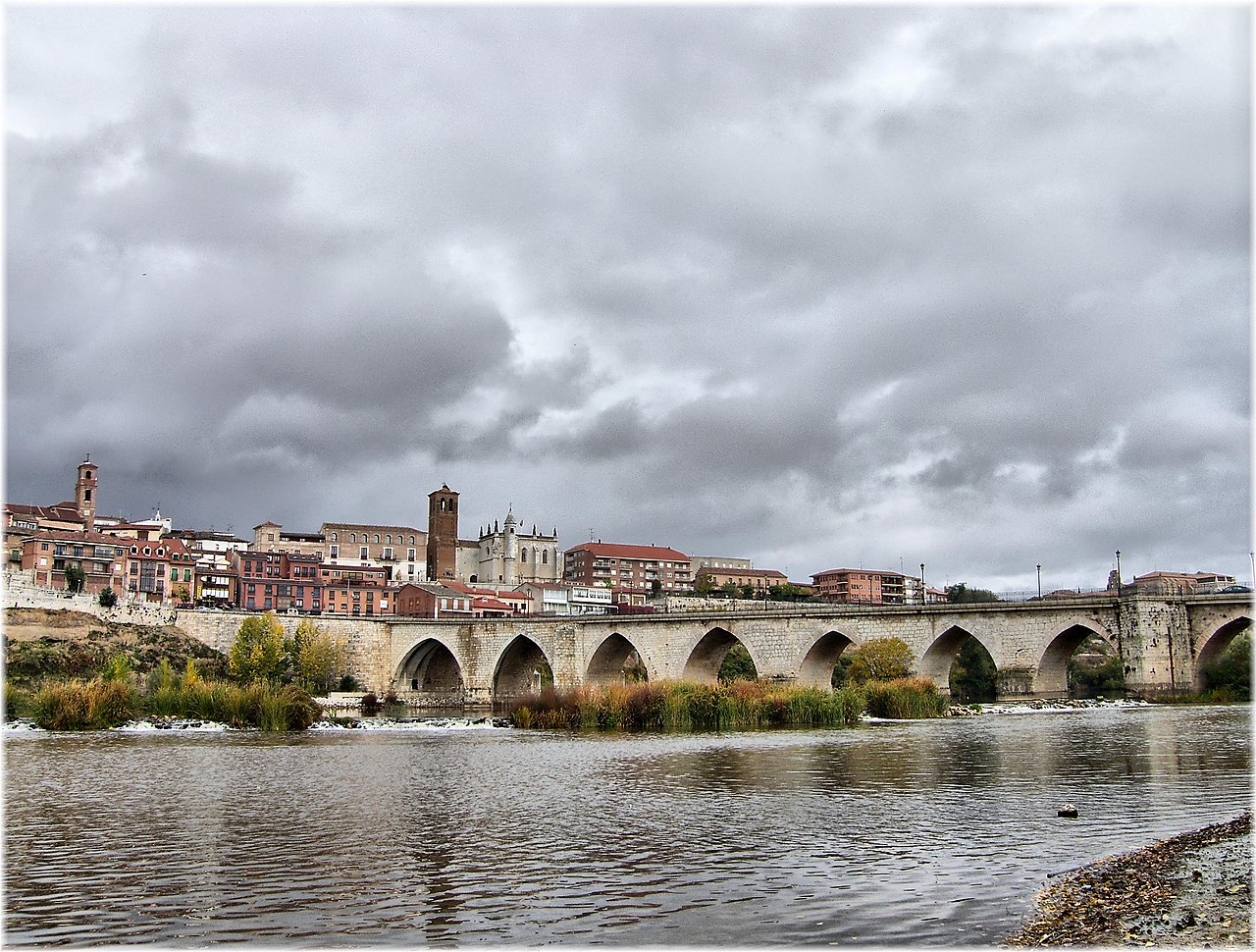
The medieval stone bridge over the Duero has ten pointed arches with triangular cutwaters. It was the essential crossing on roads linking northwest Iberia with the centre of the peninsula.
The Monastery of Santa Clara was built over a Mudéjar palace constructed by Alfonso XI after his victory at the Battle of the Salado in 1340, funded with the spoils of that campaign. His son Pedro I later gave it to his daughters to convert into a convent.
The church of San Antolín functions as a museum displaying artworks from the town, most notably the tomb of the Alderete family in a chapel with flamboyant Gothic tracery and pinnacles. The church of Santa María, a protected monument since 1983, combines a Gothic structure with later Herrerian modifications inspired by El Escorial. Its tall square tower is the highest point in Tordesillas.
Where to eat in Tordesillas
Ratings & restaurant data from Google.
Regional food & drink
Castilla y León is known for Cochinillo asado, Lechazo and Morcilla de Burgos, among 5 regional specialities.
Watch: Lechazo
Fiestas in Tordesillas
Dates recur annually but can shift by a few days. Confirm with the ayuntamiento before planning a trip around one.
- Virgen de la Guía8 September
Gallery
Location
Quick answers
Is Tordesillas worth visiting?▾
Sitting above the Duero on the old road between northwest Spain and the Castilian heartland, Tordesillas is where a treaty once divided the New World and where a queen spent forty-six years confined in a royal monastery.
Why is Tordesillas a heritage town?▾
Tordesillas is officially designated a Conjunto Histórico, Spain's national heritage designation for historic ensembles.
What is the traditional food in Castilla y León?▾
Castilla y León is known for Cochinillo asado, Lechazo, Morcilla de Burgos and Sopa de ajo. You'll find these regional specialities in and around Tordesillas.
What is there to see in Tordesillas?▾
The old street plan follows two perpendicular axes meeting at the Plaza Mayor, a layout that echoes the Roman military camp. The plaza itself is a near-perfect square, fully arcaded, with two-storey houses whose ground floors hold shops and whose upper facades carry large windows and balconies built to overlook festivals and public spectacles.
What is the history of Tordesillas?▾
The site began as a fortified high ground used to watch over the empty plains of early Castile, alongside similar lookout points at Zamora, Toro and Simancas. In the tenth century, García, eldest son of Alfonso III, used this prominence as a base for repopulating the region with Mozarabs and settlers from Asturias and León, giving the town its essentially Asturian-Leonese origins.
When are the fiestas in Tordesillas?▾
Tordesillas celebrates Virgen de la Guía (8 September). Dates recur annually but can shift by a few days.
Nearby heritage towns
A Castilian wine town in Valladolid with Roman roots, a history shaped by medieval battles and French occupation, and the oldest Denominación de Origen in Castilla y León.
A castle-turned-archive holding 35 million royal documents rises above the Pisuerga river in Valladolid province, where Christian and Moorish armies once fought for control of Castile.
Dominated by a vast red-brick castle and encircled by remnants of medieval walls, this Castilian market town in Valladolid province once stood at the heart of royal Spain.
A castle town on the Castilian meseta where two Renaissance church towers punctuate the skyline and a 15th-century queen's imprisonment left a permanent mark on royal history.
The former royal capital of Castile, Valladolid gave birth to Philip II and Philip IV, hosted the proclamation of Ferdinand III, and shaped the course of Spanish history from its grand plazas and palaces for centuries.
A compact walled town on the edge of the Tierra de Campos plateau, now Spain's first 'book village,' its medieval ramparts wrapped around a warren of bookshops.
A wine town above the Duero crowned by a richly carved 12th-century collegiate church, with a historic core of eleven protected monuments and sweeping river views.
Visiting from a nearby city?
Tordesillas makes a great day trip from:
Last updated 17 June 2026.