Girona · Cataluña
Castelló d'Empúries
- Province
- Girona
- Status
- Conjunto Histórico
- Population
- 12,201
- Elevation
- 17 m
Castelló d'Empúries is a heritage town in the province of Girona, Cataluña, Spain. It is designated a Conjunto Histórico (Spain's national heritage designation for historic ensembles). Population 12,201 (2025), elevation 17m.
Once the capital of the County of Empúries, this Girona town holds a cathedral-scale Gothic church, medieval walls, convents, and a Jewish quarter within a historic centre that has kept its medieval street plan largely intact.
Key facts
- Province
- Girona
- Heritage status
- Conjunto Histórico
- Population
- 12,201 (2025)
- Elevation
- 17 m
History of Castelló d'Empúries
The town first appears in the records in 879. By 1064 the counts of Empúries had moved their seat here from the old Roman city of Empúries, and that same year the church of Santa María was consecrated for the first time in its original Romanesque form. A substantial Jewish community grew up within the town walls, at its peak around 300 people, with two synagogues, until the Jews were expelled by royal decree in 1492.
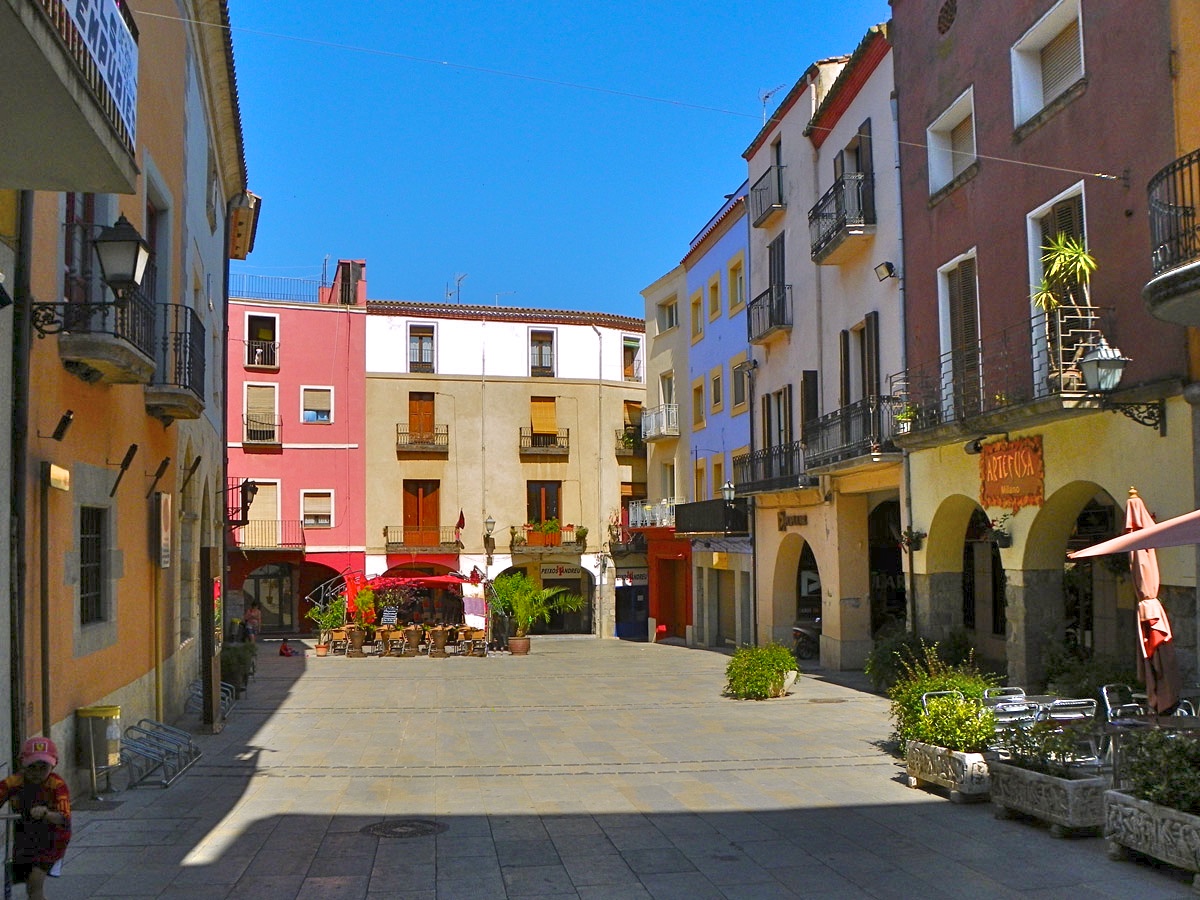
The medieval period was the town's high point; the historic centre still preserves much of its layout from that era, including arcaded squares, palaces, and monasteries.
Heritage & Monuments
The church of Santa María dominates the town. Gothic in style, it is cathedral-sized, the counts of Empúries repeatedly tried to have it raised to cathedral status and never succeeded. Construction began in the medieval period and finished when the marble portal facade was added.
The bell tower predates the Gothic nave and follows the Lombard Romanesque tradition. The old town holds several other medieval civic buildings worth seeking out. The Llotja (Exchange), dating from around 1393, served as both town hall and maritime exchange; inside, a Gothic ribbed vault carries the town's emblem at its keystone.
Nearby, the Cúria i Presó (courthouse and prison), built around 1336, still has graffiti scratched into the walls by former inmates. The Portal de la Gallarda, a rectangular Gothic tower, was the eastern gate through the town walls. The Casa Gran, an austere example of Catalan civil Gothic, stands out for its sober facade and two slim windows.
The Pont Vell crosses the river Muga on seven arches of unequal width, rebuilt many times after flood and war damage. Three convents survive in various states. Santa Clara was founded outside the walls in 1260 and moved inside in 1683; its single-nave church and plain arcaded cloister are still intact.
The Convent de la Mercè, founded in 1238, retains two Renaissance cloister galleries. The Convent de Santa Magdalena retains a fragment of a Jewish funerary slab set into its church doorway. Surrounding the town, the Aiguamolls de l'Empordà natural park covers 4,730 hectares of wetlands, more than half of which fall within the municipal boundary, with ponds, marshes, beaches, and irrigation channels supporting rich plant and animal life.
Museums in Castelló d'Empúries
Museum data and ratings from Google. Check opening hours before you go.
Practical Travel Info
The nearest airports are Girona-Costa Brava in Spain and Perpignan–Rivesaltes across the border in France. Figueres, 10 km away, has a high-speed rail station with connections to Barcelona, Madrid, and the French TGV network; from France, trains run from Montpellier and Perpignan to the Spanish border, then onward to Figueres. The town is also 10 km from Roses, and a regular bus line runs along this county axis.
As of January 2024, Castelló d'Empúries and its approach roads have 5G coverage from all Spanish carriers.
Where to stay in Castelló d'Empúries
Hotels, guesthouses and holiday rentals in and around Castelló d'Empúries, with live prices.
Search all places to stay in Castelló d'Empúries on Booking.com →Affiliate links: if you book, Castizo Spain may earn a commission at no extra cost to you. More
Where to eat in Castelló d'Empúries
Ratings & restaurant data from Google.
Regional food & drink
Cataluña is known for Pa amb tomàquet, Escalivada and Calçots, among 6 regional specialities.
Watch: Cava
Gallery
Location
Quick answers
Is Castelló d'Empúries worth visiting?▾
Once the capital of the County of Empúries, this Girona town holds a cathedral-scale Gothic church, medieval walls, convents, and a Jewish quarter within a historic centre that has kept its medieval street plan largely intact.
Why is Castelló d'Empúries a heritage town?▾
Castelló d'Empúries is officially designated a Conjunto Histórico, Spain's national heritage designation for historic ensembles.
What is the traditional food in Cataluña?▾
Cataluña is known for Pa amb tomàquet, Escalivada, Calçots and Botifarra. You'll find these regional specialities in and around Castelló d'Empúries.
Where is Castelló d'Empúries?▾
Castelló d'Empúries lies in Alto Ampurdán, in the province of Girona, Cataluña, Spain.
How big is Castelló d'Empúries?▾
Castelló d'Empúries has a population of about 12,201 (2025), and sits at 17 m above sea level.
What is there to see in Castelló d'Empúries?▾
The church of Santa María dominates the town. Gothic in style, it is cathedral-sized, the counts of Empúries repeatedly tried to have it raised to cathedral status and never succeeded.
Nearby heritage towns
A castle town in Girona with medieval walls, a chronicle writer's birthplace, and one of the world's great private libraries locked inside a restored French-style fortress.
A small walled town on the Catalan coast where a Greek trading post founded by Phocaean sailors from Marseille eventually gave way to medieval walls, a fortified Gothic church, and a castle that has been burned, besieged, and rebuilt across two thousand years of history.
A whitewashed fishing town on the rocky Cap de Creus peninsula in Girona, long favoured by Salvador Dalí, Marcel Duchamp, and Picasso, where deep geographic isolation preserved both its dialect and its architecture.
Capital of the Pla de l'Estany comarca in Girona province, Banyoles sits on the shore of the second-largest natural lake in the Iberian Peninsula, a body of water so suited to rowing that it hosted the 1992 Olympic Games and the 2004 World Rowing Championships.
A former independent county capital in Girona, its medieval bridges, Jewish baths, Romanesque monastery, and Gothic palace forming one of Catalonia's most coherent surviving medieval ensembles.
A medieval hilltop town in Girona with intact walls, a Gothic quarter of stone arches and ogival windows, and a Romanesque tower that has marked the hours since the Middle Ages.
Visiting from a nearby city?
Castelló d'Empúries makes a great day trip from:
Last updated 14 July 2026.